A separable filter in image processing can be written as product of two more simple filters. Typically a 2-dimensional convolution operation is separated into two 1-dimensional filters. This reduces the computational costs on an N × M {\displaystyle N\times M} image with a m × n {\displaystyle m\times n} filter from O ( M ⋅ N ⋅ m ⋅ n ) {\displaystyle {\mathcal {O}}(M\cdot N\cdot m\cdot n)} down to O ( M ⋅ N ⋅ ( m + n ) ) {\displaystyle {\mathcal {O}}(M\cdot N\cdot (m+n))} . == Examples == 1. A two-dimensional smoothing filter: 1 3 [ 1 1 1 ] ∗ 1 3 [ 1 1 1 ] = 1 9 [ 1 1 1 1 1 1 1 1 1 ] {\displaystyle {\frac {1}{3}}{\begin{bmatrix}1\\1\\1\end{bmatrix}}{\frac {1}{3}}{\begin{bmatrix}1&1&1\end{bmatrix}}={\frac {1}{9}}{\begin{bmatrix}1&1&1\\1&1&1\\1&1&1\end{bmatrix}}} 2. Another two-dimensional smoothing filter with stronger weight in the middle: 1 4 [ 1 2 1 ] ∗ 1 4 [ 1 2 1 ] = 1 16 [ 1 2 1 2 4 2 1 2 1 ] {\displaystyle {\frac {1}{4}}{\begin{bmatrix}1\\2\\1\end{bmatrix}}{\frac {1}{4}}{\begin{bmatrix}1&2&1\end{bmatrix}}={\frac {1}{16}}{\begin{bmatrix}1&2&1\\2&4&2\\1&2&1\end{bmatrix}}} 3. The Sobel operator, used commonly for edge detection: [ 1 2 1 ] ∗ [ 1 0 − 1 ] = [ 1 0 − 1 2 0 − 2 1 0 − 1 ] {\displaystyle {\begin{bmatrix}1\\2\\1\end{bmatrix}}{\begin{bmatrix}1&0&-1\end{bmatrix}}={\begin{bmatrix}1&0&-1\\2&0&-2\\1&0&-1\end{bmatrix}}} This works also for the Prewitt operator. In the examples, there is a cost of 3 multiply–accumulate operations for each vector which gives six total (horizontal and vertical). This is compared to the nine operations for the full 3x3 matrix. Another notable example of a separable filter is the Gaussian blur whose performance can be greatly improved the bigger the convolution window becomes.
Non-human
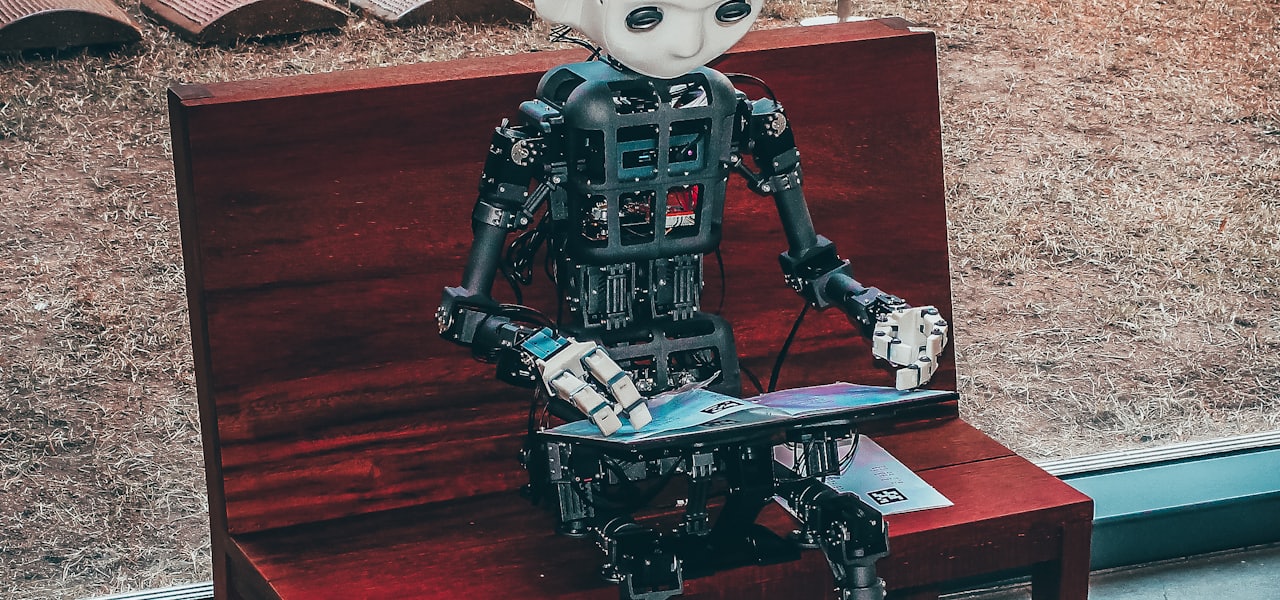
Non-human (also spelled nonhuman) is any entity displaying some, but not enough, human characteristics to be considered a human. The term has been used in a variety of contexts and may refer to objects that have been developed with human intelligence, such as robots or vehicles. == Organisms == === Animal rights and personhood === In the animal rights movement, it is common to distinguish between "human animals" and "non-human animals". Participants in the animal rights movement generally recognize that non-human animals have some similar characteristics to those of human persons. For example, various non-human animals have been shown to register pain, compassion, memory, and some cognitive function. Some animal rights activists argue that the similarities between human and non-human animals justify giving non-human animals rights that human society has afforded to humans, such as the right to self-preservation, and some even wish for all non-human animals or at least those that bear a fully thinking and conscious mind, such as vertebrates and some invertebrates such as cephalopods, to be given a full right of personhood. === The non-human in philosophy === Contemporary philosophers have drawn on the work of Henri Bergson, Gilles Deleuze, Félix Guattari, and Claude Lévi-Strauss (among others) to suggest that the non-human poses epistemological and ontological problems for humanist and post-humanist ethics, and have linked the study of non-humans to materialist and ethological approaches to the study of society and culture. == Software and robots == The term non-human has been used to describe computer programs and robot-like devices that display some human-like characteristics. In both science fiction and in the real world, computer programs and robots have been built to perform tasks that require human-computer interactions in a manner that suggests sentience and compassion. There is increasing interest in the use of robots in nursing homes and to provide elder care. Computer programs have been used for years in schools to provide one-on-one education with children. The Tamagotchi toy required children to provide care, attention, and nourishment to keep it "alive".
Tucker decomposition
In mathematics, Tucker decomposition decomposes a tensor into a set of matrices and one small core tensor. It is named after Ledyard R. Tucker although it goes back to Hitchcock in 1927. Initially described as a three-mode extension of factor analysis and principal component analysis it may actually be generalized to higher mode analysis, which is also called higher-order singular value decomposition (HOSVD) or the M-mode SVD. The algorithm to which the literature typically refers when discussing the Tucker decomposition or the HOSVD is the M-mode SVD algorithm introduced by Vasilescu and Terzopoulos, but misattributed to Tucker or De Lathauwer etal. It may be regarded as a more flexible PARAFAC (parallel factor analysis) model. In PARAFAC the core tensor is restricted to be "diagonal". In practice, Tucker decomposition is used as a modelling tool. For instance, it is used to model three-way (or higher way) data by means of relatively small numbers of components for each of the three or more modes, and the components are linked to each other by a three- (or higher-) way core array. The model parameters are estimated in such a way that, given fixed numbers of components, the modelled data optimally resemble the actual data in the least squares sense. The model gives a summary of the information in the data, in the same way as principal components analysis does for two-way data. For a 3rd-order tensor T ∈ F n 1 × n 2 × n 3 {\displaystyle T\in F^{n_{1}\times n_{2}\times n_{3}}} , where F {\displaystyle F} is either R {\displaystyle \mathbb {R} } or C {\displaystyle \mathbb {C} } , Tucker Decomposition can be denoted as follows, T = T × 1 U ( 1 ) × 2 U ( 2 ) × 3 U ( 3 ) {\displaystyle T={\mathcal {T}}\times _{1}U^{(1)}\times _{2}U^{(2)}\times _{3}U^{(3)}} where T ∈ F d 1 × d 2 × d 3 {\displaystyle {\mathcal {T}}\in F^{d_{1}\times d_{2}\times d_{3}}} is the core tensor, a 3rd-order tensor that contains the 1-mode, 2-mode and 3-mode singular values of T {\displaystyle T} , which are defined as the Frobenius norm of the 1-mode, 2-mode and 3-mode slices of tensor T {\displaystyle {\mathcal {T}}} respectively. U ( 1 ) , U ( 2 ) , U ( 3 ) {\displaystyle U^{(1)},U^{(2)},U^{(3)}} are unitary matrices in F d 1 × n 1 , F d 2 × n 2 , F d 3 × n 3 {\displaystyle F^{d_{1}\times n_{1}},F^{d_{2}\times n_{2}},F^{d_{3}\times n_{3}}} respectively. The k-mode product (k = 1, 2, 3) of T {\displaystyle {\mathcal {T}}} by U ( k ) {\displaystyle U^{(k)}} is denoted as T × U ( k ) {\displaystyle {\mathcal {T}}\times U^{(k)}} with entries as ( T × 1 U ( 1 ) ) ( i 1 , j 2 , j 3 ) = ∑ j 1 = 1 d 1 T ( j 1 , j 2 , j 3 ) U ( 1 ) ( j 1 , i 1 ) ( T × 2 U ( 2 ) ) ( j 1 , i 2 , j 3 ) = ∑ j 2 = 1 d 2 T ( j 1 , j 2 , j 3 ) U ( 2 ) ( j 2 , i 2 ) ( T × 3 U ( 3 ) ) ( j 1 , j 2 , i 3 ) = ∑ j 3 = 1 d 3 T ( j 1 , j 2 , j 3 ) U ( 3 ) ( j 3 , i 3 ) {\displaystyle {\begin{aligned}({\mathcal {T}}\times _{1}U^{(1)})(i_{1},j_{2},j_{3})&=\sum _{j_{1}=1}^{d_{1}}{\mathcal {T}}(j_{1},j_{2},j_{3})U^{(1)}(j_{1},i_{1})\\({\mathcal {T}}\times _{2}U^{(2)})(j_{1},i_{2},j_{3})&=\sum _{j_{2}=1}^{d_{2}}{\mathcal {T}}(j_{1},j_{2},j_{3})U^{(2)}(j_{2},i_{2})\\({\mathcal {T}}\times _{3}U^{(3)})(j_{1},j_{2},i_{3})&=\sum _{j_{3}=1}^{d_{3}}{\mathcal {T}}(j_{1},j_{2},j_{3})U^{(3)}(j_{3},i_{3})\end{aligned}}} Altogether, the decomposition may also be written more directly as T ( i 1 , i 2 , i 3 ) = ∑ j 1 = 1 d 1 ∑ j 2 = 1 d 2 ∑ j 3 = 1 d 3 T ( j 1 , j 2 , j 3 ) U ( 1 ) ( j 1 , i 1 ) U ( 2 ) ( j 2 , i 2 ) U ( 3 ) ( j 3 , i 3 ) {\displaystyle T(i_{1},i_{2},i_{3})=\sum _{j_{1}=1}^{d_{1}}\sum _{j_{2}=1}^{d_{2}}\sum _{j_{3}=1}^{d_{3}}{\mathcal {T}}(j_{1},j_{2},j_{3})U^{(1)}(j_{1},i_{1})U^{(2)}(j_{2},i_{2})U^{(3)}(j_{3},i_{3})} Taking d i = n i {\displaystyle d_{i}=n_{i}} for all i {\displaystyle i} is always sufficient to represent T {\displaystyle T} exactly, but often T {\displaystyle T} can be compressed or efficiently approximately by choosing d i < n i {\displaystyle d_{i} Multifactor dimensionality reduction (MDR) is a statistical approach, also used in machine learning automatic approaches, for detecting and characterizing combinations of attributes or independent variables that interact to influence a dependent or class variable. MDR was designed specifically to identify nonadditive interactions among discrete variables that influence a binary outcome and is considered a nonparametric and model-free alternative to traditional statistical methods such as logistic regression. The basis of the MDR method is a constructive induction or feature engineering algorithm that converts two or more variables or attributes to a single attribute. This process of constructing a new attribute changes the representation space of the data. The end goal is to create or discover a representation that facilitates the detection of nonlinear or nonadditive interactions among the attributes such that prediction of the class variable is improved over that of the original representation of the data. == Illustrative example == Consider the following simple example using the exclusive OR (XOR) function. XOR is a logical operator that is commonly used in data mining and machine learning as an example of a function that is not linearly separable. The table below represents a simple dataset where the relationship between the attributes (X1 and X2) and the class variable (Y) is defined by the XOR function such that Y = X1 XOR X2. Table 1 A machine learning algorithm would need to discover or approximate the XOR function in order to accurately predict Y using information about X1 and X2. An alternative strategy would be to first change the representation of the data using constructive induction to facilitate predictive modeling. The MDR algorithm would change the representation of the data (X1 and X2) in the following manner. MDR starts by selecting two attributes. In this simple example, X1 and X2 are selected. Each combination of values for X1 and X2 are examined and the number of times Y=1 and/or Y=0 is counted. In this simple example, Y=1 occurs zero times and Y=0 occurs once for the combination of X1=0 and X2=0. With MDR, the ratio of these counts is computed and compared to a fixed threshold. Here, the ratio of counts is 0/1 which is less than our fixed threshold of 1. Since 0/1 < 1 we encode a new attribute (Z) as a 0. When the ratio is greater than one we encode Z as a 1. This process is repeated for all unique combinations of values for X1 and X2. Table 2 illustrates our new transformation of the data. Table 2 The machine learning algorithm now has much less work to do to find a good predictive function. In fact, in this very simple example, the function Y = Z has a classification accuracy of 1. A nice feature of constructive induction methods such as MDR is the ability to use any data mining or machine learning method to analyze the new representation of the data. Decision trees, neural networks, or a naive Bayes classifier could be used in combination with measures of model quality such as balanced accuracy and mutual information. == Machine learning with MDR == As illustrated above, the basic constructive induction algorithm in MDR is very simple. However, its implementation for mining patterns from real data can be computationally complex. As with any machine learning algorithm there is always concern about overfitting. That is, machine learning algorithms are good at finding patterns in completely random data. It is often difficult to determine whether a reported pattern is an important signal or just chance. One approach is to estimate the generalizability of a model to independent datasets using methods such as cross-validation. Models that describe random data typically don't generalize. Another approach is to generate many random permutations of the data to see what the data mining algorithm finds when given the chance to overfit. Permutation testing makes it possible to generate an empirical p-value for the result. Replication in independent data may also provide evidence for an MDR model but can be sensitive to difference in the data sets. These approaches have all been shown to be useful for choosing and evaluating MDR models. An important step in a machine learning exercise is interpretation. Several approaches have been used with MDR including entropy analysis and pathway analysis. Tips and approaches for using MDR to model gene-gene interactions have been reviewed. == Extensions to MDR == Numerous extensions to MDR have been introduced. These include family-based methods, fuzzy methods, covariate adjustment, odds ratios, risk scores, survival methods, robust methods, methods for quantitative traits, and many others. == Applications of MDR == MDR has mostly been applied to detecting gene-gene interactions or epistasis in genetic studies of common human diseases such as atrial fibrillation, autism, bladder cancer, breast cancer, cardiovascular disease, hypertension, obesity, pancreatic cancer, prostate cancer and tuberculosis. It has also been applied to other biomedical problems such as the genetic analysis of pharmacology outcomes. A central challenge is the scaling of MDR to big data such as that from genome-wide association studies (GWAS). Several approaches have been used. One approach is to filter the features prior to MDR analysis. This can be done using biological knowledge through tools such as BioFilter. It can also be done using computational tools such as ReliefF. Another approach is to use stochastic search algorithms such as genetic programming to explore the search space of feature combinations. Yet another approach is a brute-force search using high-performance computing. == Implementations == www.epistasis.org provides an open-source and freely-available MDR software package. An R package for MDR. An sklearn-compatible Python implementation. An R package for Model-Based MDR. MDR in Weka. Generalized MDR. In statistics, the k-nearest neighbors algorithm (k-NN) is a non-parametric supervised learning method. It was first developed by Evelyn Fix and Joseph Hodges in 1951, and later expanded by Thomas Cover. In classification, a new example is assigned a label based on the labels of its k nearest training examples; in regression, the prediction is computed from the values of those neighbors. Most often, it is used for classification, as a k-NN classifier, the output of which is a class membership. An object is classified by a plurality vote of its neighbors, with the object being assigned to the class most common among its k nearest neighbors (k is a positive integer, typically small). If k = 1, then the object is simply assigned to the class of that single nearest neighbor. The k-NN algorithm can also be generalized for regression. In k-NN regression, also known as nearest neighbor smoothing, the output is the property value for the object. This value is the average of the values of k nearest neighbors. If k = 1, then the output is simply assigned to the value of that single nearest neighbor, also known as nearest neighbor interpolation. For both classification and regression, a useful technique can be to assign weights to the contributions of the neighbors, so that nearer neighbors contribute more to the average than distant ones. For example, a common weighting scheme consists of giving each neighbor a weight of 1/d, where d is the distance to the neighbor. The input consists of the k closest training examples in a data set. The neighbors are taken from a set of objects for which the class (for k-NN classification) or the object property value (for k-NN regression) is known. This can be thought of as the training set for the algorithm, though no explicit training step is required. A peculiarity (sometimes even a disadvantage) of the k-NN algorithm is its sensitivity to the local structure of the data. In k-NN classification the function is only approximated locally and all computation is deferred until function evaluation. Since this algorithm relies on distance, if the features represent different physical units or come in vastly different scales, then feature-wise normalizing of the training data can greatly improve its accuracy. == Statistical setting == Suppose we have pairs ( X 1 , Y 1 ) , ( X 2 , Y 2 ) , … , ( X n , Y n ) {\displaystyle (X_{1},Y_{1}),(X_{2},Y_{2}),\dots ,(X_{n},Y_{n})} taking values in R d × { 1 , 2 } {\displaystyle \mathbb {R} ^{d}\times \{1,2\}} , where Y is the class label of X, so that X | Y = r ∼ P r {\displaystyle X|Y=r\sim P_{r}} for r = 1 , 2 {\displaystyle r=1,2} (and probability distributions P r {\displaystyle P_{r}} ). Given some norm ‖ ⋅ ‖ {\displaystyle \|\cdot \|} on R d {\displaystyle \mathbb {R} ^{d}} and a point x ∈ R d {\displaystyle x\in \mathbb {R} ^{d}} , let ( X ( 1 ) , Y ( 1 ) ) , … , ( X ( n ) , Y ( n ) ) {\displaystyle (X_{(1)},Y_{(1)}),\dots ,(X_{(n)},Y_{(n)})} be a reordering of the training data such that ‖ X ( 1 ) − x ‖ ≤ ⋯ ≤ ‖ X ( n ) − x ‖ {\displaystyle \|X_{(1)}-x\|\leq \dots \leq \|X_{(n)}-x\|} . == Algorithm == The training examples are vectors in a multidimensional feature space, each with a class label. The training phase of the algorithm consists only of storing the feature vectors and class labels of the training samples. In the classification phase, k is a user-defined constant, and an unlabeled vector (a query or test point) is classified by assigning the label which is most frequent among the k training samples nearest to that query point. A commonly used distance metric for continuous variables is Euclidean distance. For discrete variables, such as for text classification, another metric can be used, such as the overlap metric (or Hamming distance). In the context of gene expression microarray data, for example, k-NN has been employed with correlation coefficients, such as Pearson and Spearman, as a metric. Often, the classification accuracy of k-NN can be improved significantly if the distance metric is learned with specialized algorithms such as large margin nearest neighbor or neighborhood components analysis. A drawback of the basic "majority voting" classification occurs when the class distribution is skewed. That is, examples of a more frequent class tend to dominate the prediction of the new example, because they tend to be common among the k nearest neighbors due to their large number. One way to overcome this problem is to weight the classification, taking into account the distance from the test point to each of its k nearest neighbors. The class (or value, in regression problems) of each of the k nearest points is multiplied by a weight proportional to the inverse of the distance from that point to the test point. Another way to overcome skew is by abstraction in data representation. For example, in a self-organizing map (SOM), each node is a representative (a center) of a cluster of similar points, regardless of their density in the original training data. k-NN can then be applied to the SOM. == Parameter selection == The best choice of k depends upon the data; generally, larger values of k reduces effect of the noise on the classification, but make boundaries between classes less distinct. A good k can be selected by various heuristic techniques (see hyperparameter optimization). The special case where the class is predicted to be the class of the closest training sample (i.e. when k = 1) is called the nearest neighbor algorithm. The accuracy of the k-NN algorithm can be severely degraded by the presence of noisy or irrelevant features, or if the feature scales are not consistent with their importance. Much research effort has been put into selecting or scaling features to improve classification. A particularly popular approach is the use of evolutionary algorithms to optimize feature scaling. Another popular approach is to scale features by the mutual information of the training data with the training classes. In binary (two class) classification problems, it is helpful to choose k to be an odd number as this avoids tied votes. One popular way of choosing the empirically optimal k in this setting is via bootstrap method. == The 1-nearest neighbor classifier == The most intuitive nearest neighbour type classifier is the one nearest neighbour classifier that assigns a point x to the class of its closest neighbour in the feature space, that is C n 1 n n ( x ) = Y ( 1 ) {\displaystyle C_{n}^{1nn}(x)=Y_{(1)}} . As the size of training data set approaches infinity, the one nearest neighbour classifier guarantees an error rate of no worse than twice the Bayes error rate (the minimum achievable error rate given the distribution of the data). == The weighted nearest neighbour classifier == The k-nearest neighbour classifier can be viewed as assigning the k nearest neighbours a weight 1 / k {\displaystyle 1/k} and all others 0 weight. This can be generalised to weighted nearest neighbour classifiers. That is, where the ith nearest neighbour is assigned a weight w n i {\displaystyle w_{ni}} , with ∑ i = 1 n w n i = 1 {\textstyle \sum _{i=1}^{n}w_{ni}=1} . An analogous result on the strong consistency of weighted nearest neighbour classifiers also holds. Let C n w n n {\displaystyle C_{n}^{wnn}} denote the weighted nearest classifier with weights { w n i } i = 1 n {\displaystyle \{w_{ni}\}_{i=1}^{n}} . Subject to regularity conditions, which in asymptotic theory are conditional variables which require assumptions to differentiate among parameters with some criteria. On the class distributions the excess risk has the following asymptotic expansion R R ( C n w n n ) − R R ( C Bayes ) = ( B 1 s n 2 + B 2 t n 2 ) { 1 + o ( 1 ) } , {\displaystyle {\mathcal {R}}_{\mathcal {R}}(C_{n}^{wnn})-{\mathcal {R}}_{\mathcal {R}}(C^{\text{Bayes}})=\left(B_{1}s_{n}^{2}+B_{2}t_{n}^{2}\right)\{1+o(1)\},} for constants B 1 {\displaystyle B_{1}} and B 2 {\displaystyle B_{2}} where s n 2 = ∑ i = 1 n w n i 2 {\displaystyle s_{n}^{2}=\sum _{i=1}^{n}w_{ni}^{2}} and t n = n − 2 / d ∑ i = 1 n w n i { i 1 + 2 / d − ( i − 1 ) 1 + 2 / d } {\displaystyle t_{n}=n^{-2/d}\sum _{i=1}^{n}w_{ni}\left\{i^{1+2/d}-(i-1)^{1+2/d}\right\}} . The optimal weighting scheme { w n i ∗ } i = 1 n {\displaystyle \{w_{ni}^{}\}_{i=1}^{n}} , that balances the two terms in the display above, is given as follows: set k ∗ = ⌊ B n 4 d + 4 ⌋ {\displaystyle k^{}=\lfloor Bn^{\frac {4}{d+4}}\rfloor } , w n i ∗ = 1 k ∗ [ 1 + d 2 − d 2 k ∗ 2 / d { i 1 + 2 / d − ( i − 1 ) 1 + 2 / d } ] {\displaystyle w_{ni}^{}={\frac {1}{k^{}}}\left[1+{\frac {d}{2}}-{\frac {d}{2{k^{}}^{2/d}}}\{i^{1+2/d}-(i-1)^{1+2/d}\}\right]} for i = 1 , 2 , … , k ∗ {\displaystyle i=1,2,\dots ,k^{}} and w n i ∗ = 0 {\displaystyle w_{ni}^{}=0} for i = k ∗ + 1 , … , n {\displaystyle i=k^{}+1,\dots ,n} . With optimal weights the dominant term in the asymptotic expansion of the excess risk is O ( n − 4 d + 4 ) {\displaystyle {\mathcal {O}}(n^{-{\frac {4}{d+4}}})} A message queueing service is a message-oriented middleware or MOM deployed in a compute cloud using software as a service model. Service subscribers access queues and or topics to exchange data using point-to-point or publish and subscribe patterns. It's important to differentiate between event-driven and message-driven (aka queue driven) services: Event-driven services (e.g. AWS SNS) are decoupled from their consumers. Whereas queue / message driven services (e.g. AWS SQS) are coupled with their consumers. Message queues can be a good buffer to handle spiky workloads but they have a finite capacity. According to Gregor Hohpe, message queues require proper mechanisms (aka flow controls) to avoid filling the queue beyond its manageable capacity and to keep the system stable. == Ordering Guarantees in Message Queues == Amazon SQS FIFO and Azure Service Bus sessions are queue-based messaging systems that provide ordering guarantees within a message group or session attempt but do not necessarily guarantee ordered delivery in cases of retries or failures. In SQS FIFO, messages in the same message group are processed in order, with subsequent messages held until the preceding message is successfully processed or moved to the dead-letter queue (DLQ). Once a message is placed in the DLQ, it is no longer retried, creating a gap in the sequence. However, the remaining messages continue to be delivered in order. Azure Service Bus sessions function similarly by maintaining ordering within a session, provided a single consumer processes messages sequentially. The implementation differs from SQS FIFO but follows the same fundamental ordering principle. In contrast, Apache Kafka is a distributed log-based messaging system that guarantees ordering within individual partitions rather than across the entire topic. Unlike queue-based systems, Kafka retains messages in a durable, append-only log, allowing multiple consumers to read at different offsets. Kafka uses manual offset management, giving consumers control over retries and failure handling. If a consumer fails to process a message, it can delay committing the offset, preventing further progress in that partition while other partitions remain unaffected. This partition-based design enables fault isolation and parallel processing while allowing ordering to be maintained within partitions, depending on consumer handling. == Vendors == Apache Kafka Apache Kafka is a distributed system consisting of servers that store and forward messages between producer client and consumer applications. IBM MQ IBM MQ offers a managed service that can be used on IBM Cloud and Amazon Web Services. Microsoft Azure Service Bus Service Bus offers queues, topics & subscriptions, and rules/actions in order to support publish-subscribe, temporal decoupling, and load balancing scenarios. Azure Service Bus is built on AMQP allowing any existing AMQP 1.0 client stack to interact with Service Bus directly or via existing .Net, Java, Node, and Python clients. Standard and Premium tiers allow for pay as you go or isolated resources at massive scale. Oracle Messaging Cloud Service This service provides a messaging solution for applications for asynchronous communication and is influenced by the Java Message Service (JMS) API specification. Any application platform that understands HTTP can also use Oracle Messaging Cloud Service through the REST interface. For Java applications, Oracle Messaging Cloud Service provides a Java library that implements and extends the JMS 1.1 interface. The Java library implements the JMS API by acting as a client of the REST API. Amazon Simple Queue Service Supports messages natively up to 256K, or up to 2GB by transmitting payload via S3. Highly scalable, durable and resilient. Provides loose-FIFO and 'at least once' delivery in order to provide massive scale. Supports REST API and optional Java Message Service client. Low latency. Utilizes Amazon Web Services. IronMQ Supports messages up to 64k; guarantees order; guarantees once only delivery; no delays retrieving messages. Supports REST API and beanstalkd open source protocol. Runs on multiple clouds including AWS and Rackspace. Scaling must be managed by user. RabbitMQ RabbitMQ is a reliable and mature messaging and streaming broker, which is easy to deploy on cloud environments, on-premises, and on your local machine. Supports AMQP, STOMP, MQTT StormMQ Open platform supports messages up to 50Mb. Uses AMQP to avoid vendor lock-in and provide language neutrality. Locate-It Option allows customers to audit the location of their data at all times and satisfy data protection principles. AnypointMQ An enterprise multi-tenant, cloud messaging service that performs advanced asynchronous messaging scenarios between applications. Anypoint MQ is fully integrated with Anypoint Platform, offering role based access control, client application management, and connectors. Ground truth is information that is known to be real or true, provided by direct observation and measurement (i.e. empirical evidence) as opposed to information provided by inference. The term ground truth appeared in remote sensing literature as early as 1972, when NASA described it as essential "data about ... materials on the earth's surface" used to calibrate measurements. It was later adopted by the statistical modeling and machine learning communities. == Etymology == The Oxford English Dictionary (s.v. ground truth) records the use of the word Groundtruth in the sense of 'fundamental truth' from Henry Ellison's poem "The Siberian Exile's Tale", published in 1833. == Usage == The term "ground truth" can be used as a noun, adjective, and verb. Noun: "ground truth" (no hyphen). Example: "The ground truth is essential for training accurate models." Adjective: "ground-truth" (hyphenated compound adjective). Example: "We need to use ground-truth data to validate the model." Verb: "to ground-truth" or "to groundtruth" (compound verb,). Example: "We need to ground-truth the results to ensure their accuracy." == Statistics and machine learning == In statistics and machine learning, ground truth is the ideal expected result, used in statistical models to prove or disprove research hypotheses. "Ground truthing" is the process of gathering the good data for this test. Ground truth is typically included in labeled data. In machine learning, "ground truth" is not necessarily objectively correct or true. For example, in training AI models or relevance rankers, it may be a set of judgments made by people or inferred from user behavior, which may depend on context. For example, in Bayesian spam filtering, a supervised learning system is typically trained by examples labeled as spam and non-spam. Although these labels may be subjective or inaccurate, they are considered ground truth. True ground truth in machine learning is objective data. For example, suppose we are testing a stereo vision system to see how well it can estimate 3D positions. A calibrated laser rangefinder may provide accurate distances as ground truth. == Remote sensing == In remote sensing, "ground truth" refers to information collected at the imaged location. Ground truth allows image data to be related to real features and materials on the ground. The collection of ground truth data enables calibration of remote-sensing data, and aids in the interpretation and analysis of what is being sensed. Examples include cartography, meteorology, analysis of aerial photographs, satellite imagery and other techniques in which data are gathered at a distance. More specifically, ground truth may refer to a process in which "pixels" on a satellite image are compared to what is imaged (at the time of capture) in order to verify the contents of the "pixels" in the image (noting that the concept of "pixel" is imaging-system-dependent). In the case of a classified image, supervised classification can help to determine the accuracy of the classification by the remote sensing system which can minimize error in the classification. Ground truth is usually done on site, correlating what is known with surface observations and measurements of various properties of the features of the ground resolution cells under study in the remotely sensed digital image. The process also involves taking geographic coordinates of the ground resolution cell with GPS technology and comparing those with the coordinates of the "pixel" being studied provided by the remote sensing software to understand and analyze the location errors and how it may affect a particular study. Ground truth is important in the initial supervised classification of an image. When the identity and location of land cover types are known through a combination of field work, maps, and personal experience these areas are known as training sites. The spectral characteristics of these areas are used to train the remote sensing software using decision rules for classifying the rest of the image. These decision rules such as Maximum Likelihood Classification, Parallelopiped Classification, and Minimum Distance Classification offer different techniques to classify an image. Additional ground truth sites allow the remote sensor to establish an error matrix that validates the accuracy of the classification method used. Different classification methods may have different percentages of error for a given classification project. It is important that the remote sensor chooses a classification method that works best with the number of classifications used while providing the least amount of error. Ground truth also helps with atmospheric correction. Since images from satellites have to pass through the atmosphere, they can get distorted because of absorption in the atmosphere. So ground truth can help fully identify objects in satellite photos. === Errors of commission === An example of an error of commission is when a pixel reports the presence of a feature (such a tree) that, in reality, is absent (no tree is actually present). Ground truthing ensures that the error matrices have a higher accuracy percentage than would be the case if no pixels were ground-truthed. This value is the complement of the user's accuracy, i.e. Commission Error = 1 - user's accuracy. === Errors of omission === An example of an error of omission is when pixels of a certain type, for example, maple trees, are not classified as maple trees. The process of ground-truthing helps to ensure that the pixel is classified correctly and the error matrices are more accurate. This value is the complement of the producer's accuracy, i.e. Omission Error = 1 - producer's accuracy == Geographical information systems == In GIS the spatial data is modeled as field (like in remote sensing raster images) or as object (like in vectorial map representation). They are modeled from the real world (also named geographical reality), typically by a cartographic process (illustrated). Geographic information systems such as GIS, GPS, and GNSS, have become so widespread that the term "ground truth" has taken on special meaning in that context. If the location coordinates returned by a location method such as GPS are an estimate of a location, then the "ground truth" is the actual location on Earth. A smart phone might return a set of estimated location coordinates such as 43.87870, −103.45901. The ground truth being estimated by those coordinates is the tip of George Washington's nose on Mount Rushmore. The accuracy of the estimate is the maximum distance between the location coordinates and the ground truth. We could say in this case that the estimate accuracy is 10 meters, meaning that the point on Earth represented by the location coordinates is thought to be within 10 meters of George's nose—the ground truth. In slang, the coordinates indicate where we think George Washington's nose is located, and the ground truth is where it really is. In practice a smart phone or hand-held GPS unit is routinely able to estimate the ground truth within 6–10 meters. Specialized instruments can reduce GPS measurement error to under a centimeter. == Military usage == US military slang uses "ground truth" to refer to the facts comprising a tactical situation—as opposed to intelligence reports, mission plans, and other descriptions reflecting the conative or policy-based projections of the industrial·military complex. The term appears in the title of the Iraq War documentary film The Ground Truth (2006), and also in military publications, for example Stars and Stripes saying: "Stripes decided to figure out what the ground truth was in Iraq."Multifactor dimensionality reduction
K-nearest neighbors algorithm
Message queuing service
Ground truth